John Lewis/Waitrose Loyalty Scheme
Designing one loyalty experience across two iconic brands
John Lewis and Waitrose were developing a new partnership-wide loyalty scheme that would allow customers to earn points when shopping with either brand and accumulate them in a single account.
I was asked to design the end-to-end experience for joining, migrating and onboarding customers to the new programme across both John Lewis and Waitrose.
On the surface, this sounded like an onboarding challenge. In reality, it was a complex service design problem involving two businesses, two digital ecosystems, two existing loyalty schemes and customers with very different relationships with each brand.
My challenge was to make all of that underlying complexity feel like one simple loyalty experience.
One scheme, many different starting points
There wasn't a single journey into the new programme.
John Lewis and Waitrose operated separate customer databases, and customers could already have accounts and loyalty memberships with either or both brands.
That created a range of possible starting points. A customer might have a Waitrose online account but never have joined My Waitrose. They might have a John Lewis account with My John Lewis attached. They could have online accounts with both businesses but belong to neither loyalty scheme. Or they might already be members of both.
Those differences mattered because existing loyalty accounts contained benefits and customer history that couldn't simply be discarded. For example, customers could have in-store receipts associated with their existing My John Lewis membership.
We therefore needed to preserve those existing relationships while bringing customers into a new partnership-wide loyalty model.
I defined three core journeys:
Automatic migration for customers who already belonged to both My John Lewis and My Waitrose.
Account linking for customers who belonged to one existing loyalty scheme and needed to connect their account with the other brand.
Joining for customers who belonged to neither scheme and needed to understand the benefits of the new programme before deciding to sign up.
These journeys became the foundation of the experience.
Designing around customer state
The complexity wasn't confined to registration.
Both the John Lewis and Waitrose websites needed to recognise a customer's existing relationship with the partnership and present the appropriate experience.
Someone who was already a member of both loyalty schemes didn't need to be persuaded to join. Instead, we needed to explain that they had been automatically migrated and introduce what had changed.
Someone logged into John Lewis with My John Lewis, but without My Waitrose, needed a way to link their Waitrose membership. The equivalent customer on Waitrose needed the reverse journey.
And someone who belonged to neither loyalty scheme needed something completely different: a compelling explanation of the new proposition and the benefits of joining.
I therefore designed the experience around a series of customer states and transitions, rather than as one linear onboarding funnel.
The aim was that customers would only encounter the information and actions relevant to them, regardless of which brand they started with or what relationship they already had with the partnership.
Understanding what customers would expect
Alongside understanding the internal complexity, I wanted to understand what customers would expect from a modern loyalty programme.
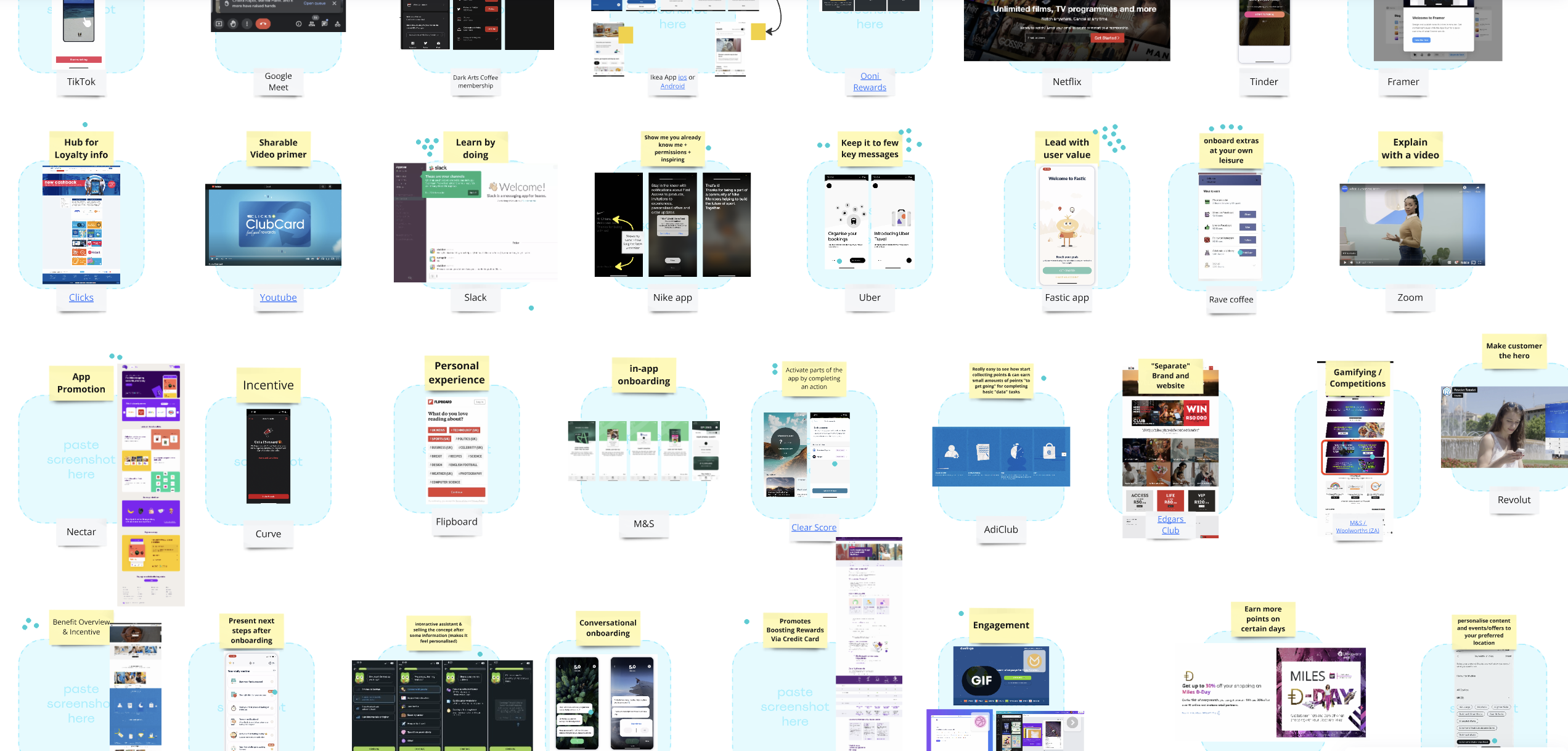
I analysed loyalty experiences across retail and digital services, looking at how other organisations approached joining, onboarding, rewards, account management and ongoing engagement.
I documented these journeys in Miro and shared them with the wider team.
Rather than treating them as solutions to copy, we used them as provocations during workshops and the design sprint: examples that helped us question what a partnership-wide loyalty experience should feel like for John Lewis and Waitrose customers.
Looking beyond the digital journey
Loyalty didn't begin or end with an account screen.
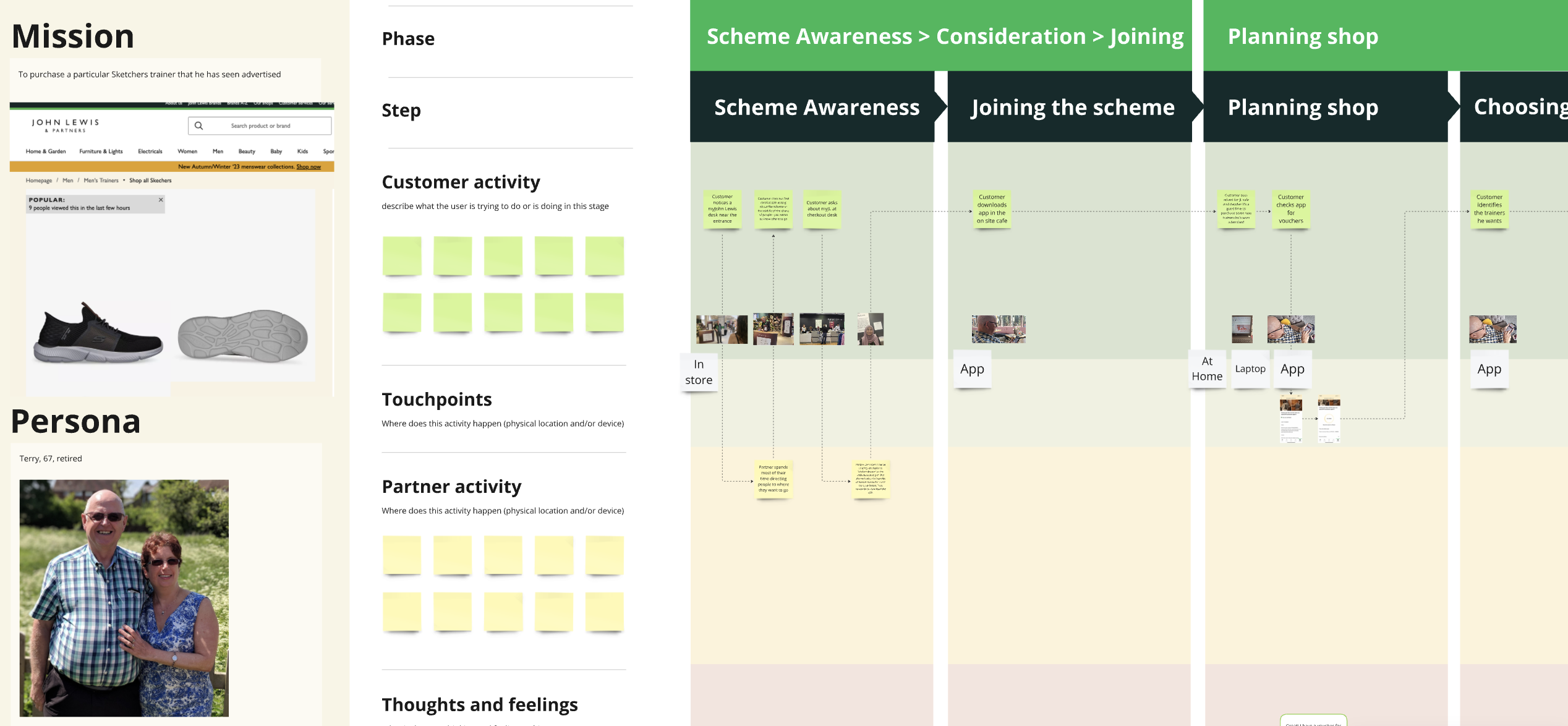
I observed customers during real in-store shopping journeys to understand when loyalty became relevant, how people engaged with existing schemes and where there were opportunities to make the value of the new proposition more visible.
This was particularly important because the new programme was designed around a genuinely cross-brand proposition.
Customers would be able to earn points through purchases at either John Lewis or Waitrose, with those points accumulating in a single account for use across the partnership.
From a customer's perspective, interactions in a Waitrose store, on the John Lewis website or through either brand's digital services therefore needed to feel like parts of the same loyalty experience.
Mapping those journeys helped us identify opportunities to improve awareness, engagement and redemption across physical and digital touchpoints.
Making the complexity behind the experience visible
Creating something simple for customers meant first understanding a considerable amount of complexity behind the scenes.
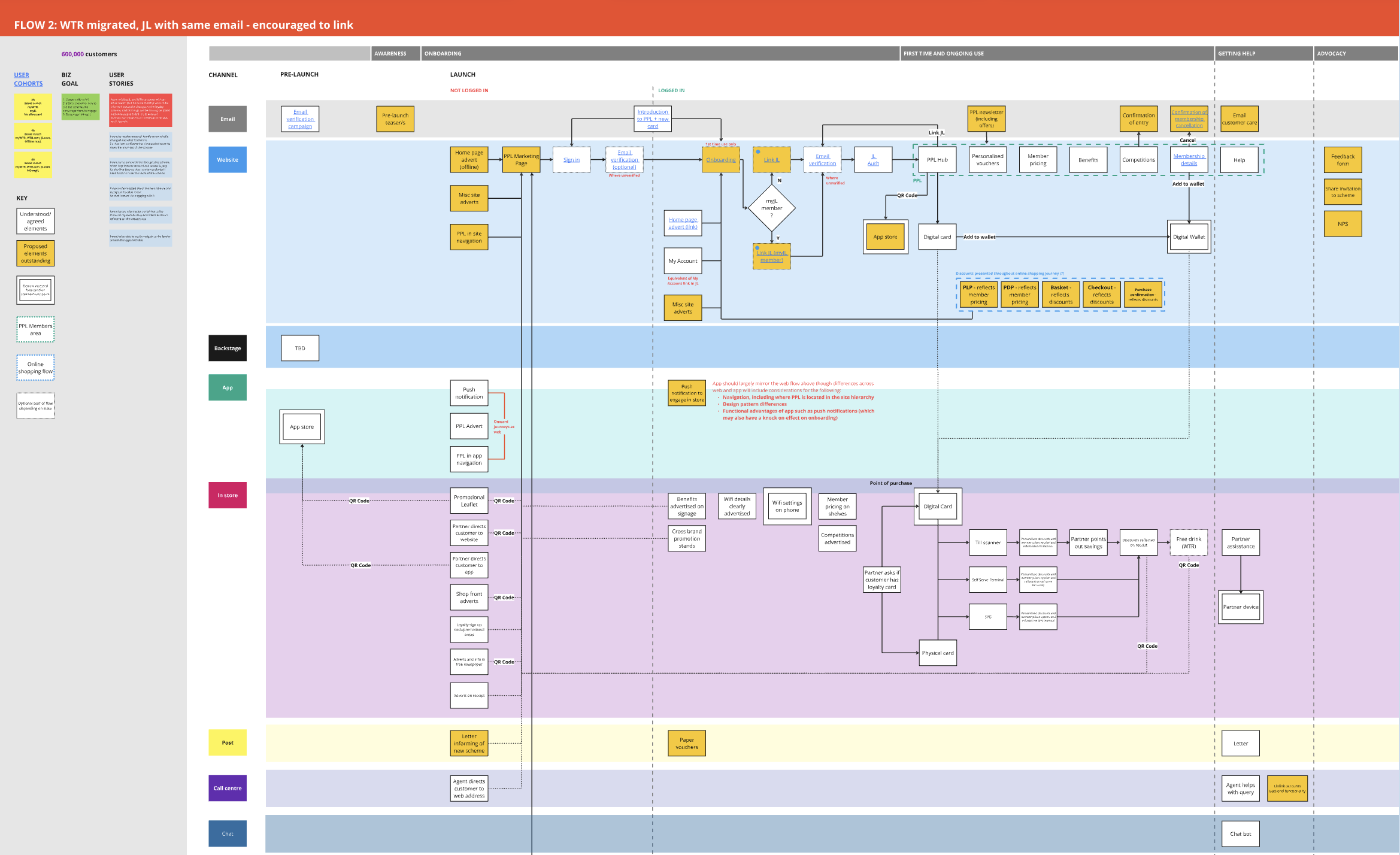
I developed service maps connecting the different customer states and journeys with the systems, data and operational processes required to support them.
This allowed us to explore what needed to happen when accounts were migrated or linked, how existing loyalty relationships could be preserved, and how the two businesses could recognise the same customer across previously separate systems.
It also helped us identify where complexity needed to be resolved by the service rather than passed on to customers.
The service maps became a way for design, technology and business stakeholders to develop a shared understanding of how the new loyalty ecosystem needed to work.
Bringing John Lewis and Waitrose around the same table
A partnership-wide loyalty programme required more than technical integration. It also required people from across both businesses to agree what the customer experience should become.
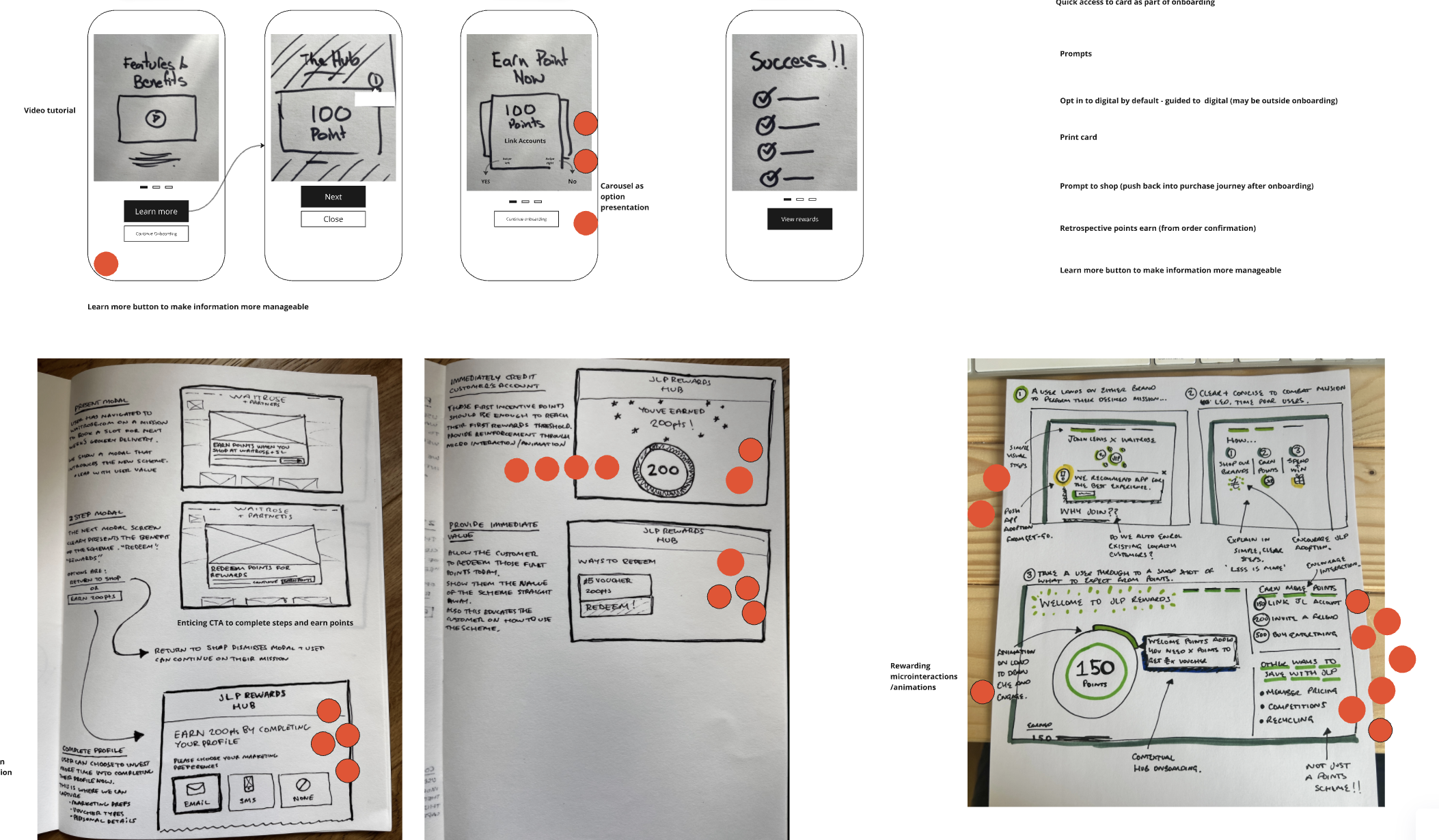
I facilitated a cross-functional design sprint bringing together stakeholders from John Lewis and Waitrose.
I structured and led the sprint, using customer research, competitor journeys and service maps as inputs to help the group explore the problem, generate and critique ideas, and converge on the strongest concepts. These were then developed collaboratively into storyboards for the future experience.
The sprint gave stakeholders a structured way to work through requirements and dependencies together rather than designing separate John Lewis and Waitrose experiences and attempting to reconcile them afterwards.
It helped establish a shared vision for how the new loyalty proposition could work across both brands and provided a clear direction for the experience design that followed.
Turning the service into something customers could experience
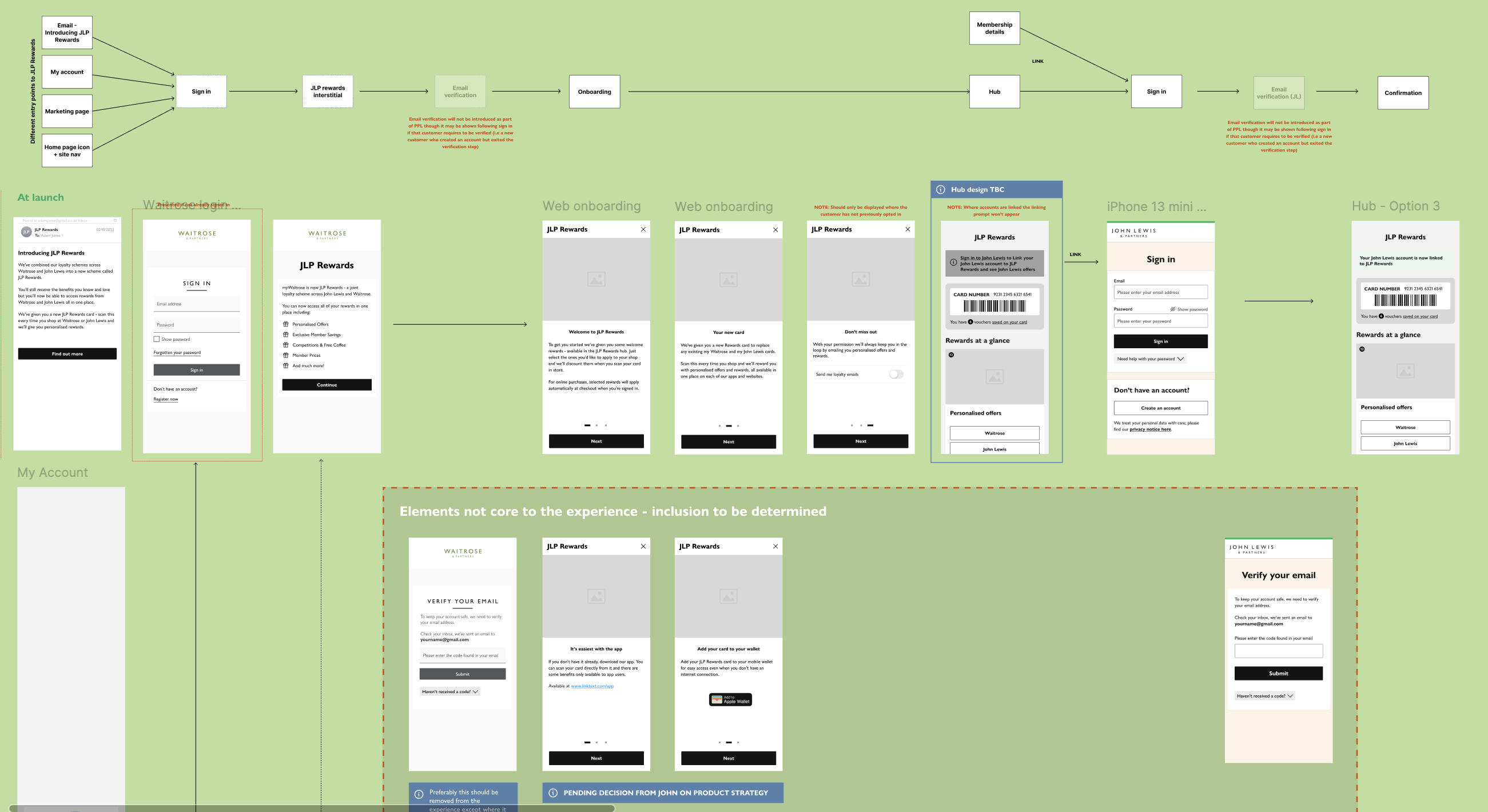
I translated the emerging service into wireframes and interactive Figma prototypes covering the key migration, linking and joining journeys.
Prototyping was particularly important because the experience changed depending on who the customer was, what accounts they already held and which website they were using.
Rather than designing a single happy path, I could explore the different states of the service and demonstrate how customers would move between them.
This allowed us to test questions such as: Do customers understand why they are being migrated? Is it clear what linking their accounts will do? Are they confident that their existing benefits will be retained? And for someone new to loyalty, is the partnership-wide points proposition compelling enough to encourage them to join?
Testing these journeys with customers allowed us to identify confusion, challenge assumptions and progressively refine the experience.
Making two loyalty ecosystems feel like one
The project produced validated experience designs for migrating existing loyalty customers, linking accounts across the two brands and onboarding entirely new members.
But the challenge was bigger than any individual journey.
Behind the experience were two businesses, separate customer databases, two existing loyalty schemes and numerous possible customer states. In front of it needed to be something much simpler: one loyalty programme, one points balance and a clear relationship with the John Lewis Partnership.
Through service mapping, customer research, collaborative design and prototyping, we turned that underlying complexity into a coherent experience and created a shared vision that stakeholders across John Lewis and Waitrose could work towards.
For me, that was the central design challenge of the project: the complexity belonged to the service, not the customer.